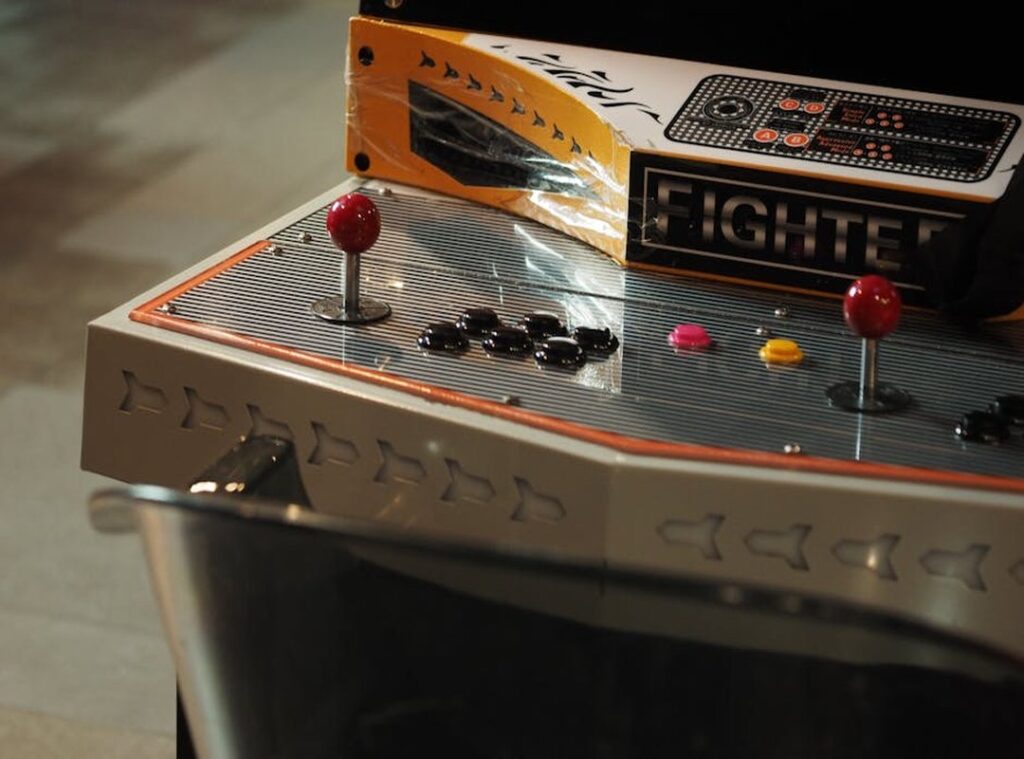
Remember the thrill of glowing screens and the clatter of coins? Those memories are solid, and they speak to a time that many gamers adore yet don’t fully understand.
I’m passionate about arcade games history and how these lively spaces shaped gaming culture. It’s frustrating when people love arcades but miss the rich story behind their evolution.
In this article, I’ll take you on a journey through the complete history of arcade gaming, from its mechanical roots to its modern-day revival. I’ll break down every major milestone and highlight the cultural impact these games had on our lives.
Why should you trust this? I’ve spent years digging into the past of gaming, and I want to share my fascination with you. I’ll make it easy to grasp, even if you’re just starting to explore.
If you’ve ever wondered how we got here, you’re in the right place. Let’s uncover the epic journey of arcade gaming together, and I’ll promise you’ll see these games in a new light.
The Genesis: From Penny Arcades to Early Electronic Wonders
Did you know the first “arcades” weren’t even electronic? Back in the late 19th and early 20th centuries, amusement parlors were all about mechanical games. Picture this: pinball machines, shooting galleries, and those old-school strength testers.
It was more about the clanging of metal than the beeping of electronics. But hey, it was a start.
Then came the mid-20th century and things got a bit more electrified. Games like ‘Periscope’ in 1966 started to lay the technical groundwork for what was to come. These weren’t video games as we know them, but they sure were a step up.
Fast forward to 1971 and we hit a milestone with ‘Computer Space.’ It was the first true electronic arcade game. Sure, it faced commercial challenges, but it set the stage for what was next.
Enter ‘Pong’ in 1972. Now, this is where things got interesting. Its simplicity and bold accessibility captured the public’s imagination.
Suddenly, arcade games were everywhere.
Remember those classic arcade environments? Dim lighting, loud noises, and pure excitement. It was a world apart from home entertainment back then.
Arcade games history really took off from there, changing how we play forever.
The Golden Age: When Arcades Ruled the World
Remember the late 70s and early 80s? A magical time when arcade games history was being written in real-time. Arcades were everywhere, buzzing with energy and the clinking sounds of quarters.
This was the “Golden Age” of arcade gaming.
Graphics were evolving. Color screens (a big deal!) brought games to life. Soundtracks started adding more than just beeps and boops.
Gameplay mechanics became more complex. Suddenly, you weren’t just playing a game. You were in it.
Let’s talk icons. ‘Space Invaders’ in 1978 was a game-changer (literally). It wasn’t just a game; it was a cultural phenomenon. Everyone was playing it.
It was on the news, talked about in schools, and even inspired a song. Then came ‘Pac-Man’ in 1980. Its design was simple, yet addictive.
Its appeal was universal. Merchandising empire? Oh, absolutely.
From lunchboxes to Saturday morning cartoons, Pac-Man was everywhere.
But the hits kept coming. ‘Donkey Kong’, ‘Centipede’, ‘Frogger’ (each) game brought something new. ‘Donkey Kong’ introduced us to a certain plumber (hello, Mario!). ‘Centipede’ offered a different shooting mechanic. And ‘Frogger’ challenged us to cross roads and rivers. Ah, the simple joys.
Arcades weren’t just about games. They were meeting spots. People gathered to compete for high scores (and bragging rights).
It was the birth of gaming culture. Dedicated arcades became pop culture staples. They appeared in movies, music videos, and even influenced fashion.
And while these classic games paved the way, they also set the stage for the Sega Sonic Revolution, which continued the legacy of innovation. Arcades weren’t just a phase. They were a revolution.
The Console Challenge: New Genres and Shifting Tides
Back in the mid-80s to early 90s, the arcade games history took a wild turn. Suddenly, home consoles like the NES were popping up, giving arcades a run for their quarters. Why go out when you could play in your pajamas?
It was convenient and cheap. But arcades didn’t just roll over. They fought back with experiences you couldn’t replicate at home.
Think about those massive cabinets and bizarre control schemes. They were larger than life. Arcades became places where you could do things a console just couldn’t handle.
Look at the fighting game explosion with “Street Fighter II” in 1991. It wasn’t just a game; it was a competitive scene. People lined up to challenge each other.
And let’s not forget the beat ’em ups like “Final Fight” and “Teenage Mutant Ninja Turtles.” Playing with friends in real time? Priceless.
Racing games and light-gun shooters were also killing it, providing those immersive, adrenaline-pumping experiences. Arcades were evolving. They weren’t just for everyone anymore.
They became havens for the hardcore gamer. Want to dive deeper? Check out coin op century a brief history for more on this changing era.
The 3D Arcade Boom: A Gamechanger
The mid-90s to early 2000s was a wild time for arcade games. Remember when Virtua Fighter blew our minds in 1993? Those 3D graphics felt like the future.

Arcades were ahead of home consoles back then, and games like ‘Daytona USA’ in 1994 were pushing boundaries.
These games weren’t just about looks. They set a new standard for gameplay. You could almost feel the rush of speed in those driving simulators.
And then came the rhythm games. ‘Dance Dance Revolution’ in 1998? Everyone was stomping on those pads. It was a cultural moment.
Light gun games like ‘Time Crisis’ kept us coming back too. They were more than just shooters; they were experiences. But with all this innovation, the cost of arcade machines skyrocketed.
It was tough for arcades to keep up as home consoles improved rapidly.
The PlayStation and Xbox started offering similar experiences, plus online multiplayer. Arcades had to find their niche. This era of arcade games history is fascinating because it’s where the arcade scene had to adapt or die.
But hey, who doesn’t miss those sticky floors and neon lights? We’ve got a lot to thank this period for in gaming evolution.
Arcades: The Comeback Kids
Arcades took a nosedive in the 2000s, right? It seemed like every arcade was being swallowed by redemption games and claws. But in countries like Japan, arcades never really left.
They evolved, becoming multi-story behemoths with everything from rhythm games to UFO catchers.
Then there’s the rise of ‘barcades’ and retro arcades here in the West. They’re genius because they mix nostalgia with social vibes. Imagine playing Pac-Man while sipping on a craft beer (perfection.) And let’s not forget VR arcades.
They’re the new frontier with immersive experiences that make your living room setup look outdated.
What draws us back to these spaces? It’s the unique atmosphere and that electric competitive spirit. Not to mention, the joy of playing with others, face-to-face.
If you’re curious about gaming’s past and how it shapes today, check out the super mario bros impact. Arcades aren’t just history; they’re living it.
Keep the Arcade Spirit Alive
Your exploration of arcade games history is done. You’ve uncovered the evolution of these iconic gaming hubs. This context matters.
It shows how innovation, culture, and community shaped our gaming experiences.
Now, I challenge you to visit a local arcade. Relive the magic of those classic titles. Share your favorite arcade memories with friends.
This legacy deserves to live on. Get out there and experience it firsthand. Don’t just read about it.
Make your own memories.